Cyndi, the collector behind the Instagram account @TheFabNab, has spent the past dozen years transforming overlooked antique jewelry into contemporary pieces that double as personal talismans. Her work began with modest acquisitions of Edwardian stickpins. Specifically, it now encompasses a growing portfolio of reimagined Victorian jewelry, spikes, celestial motifs and Egyptian Revival designs.
The Passion for Reimagining Victorian Jewelry Finds
The California-based enthusiast recalls entering the field 12 to 13 years ago, a time when stickpins were inexpensive enough to encourage experimentation. Consequently, early conversions of those pins into rings and charms provided a low-risk path into precious metals and gemstones. Moreover, this approach continues to underpin her practice today.
“Reinventing what already exists is still one of my passions,” she said, crediting those trials with shaping her Lucky Numbers + Talismans capsule collection. In addition, that line repurposes Edwardian and Art Deco components into pieces bearing numerals that clients view as symbols of destiny.
Several design threads run consistently through Cyndi’s collection. For instance, she gravitates toward medallions, religious iconography, snakes, rubies and distinctly celestial imagery. The latter spans antique diamond-studded stars to contemporary interpretations from the H. Stern Genesis series, which she praises for channeling 19th-century aesthetics. Furthermore, diamond wing motifs and Egyptian Revival scarabs in brushed gold are similarly prominent, as are vintage pocket watches paved with diamonds. Ultimately, each item balances ornamental value with a sense of personal meaning.
The Emotional Power of Wearable Talismans
The emotional aspect of jewelry is a recurring theme in Cyndi’s narrative. Therefore, whether a piece marks a celebration, a goal or a challenge overcome, she views wearables as portable reminders of specific moments. Just as the ring finger meaning carries centuries of symbolism, Cyndi’s creations act as protective layers for the wearer.
The collector likens such items to protective layers, explaining that even self-gifting can reinforce self-confidence. Additionally, this perspective informs many of her conversions, which aim to make heirloom components suitable for everyday wear without stripping them of historical context.
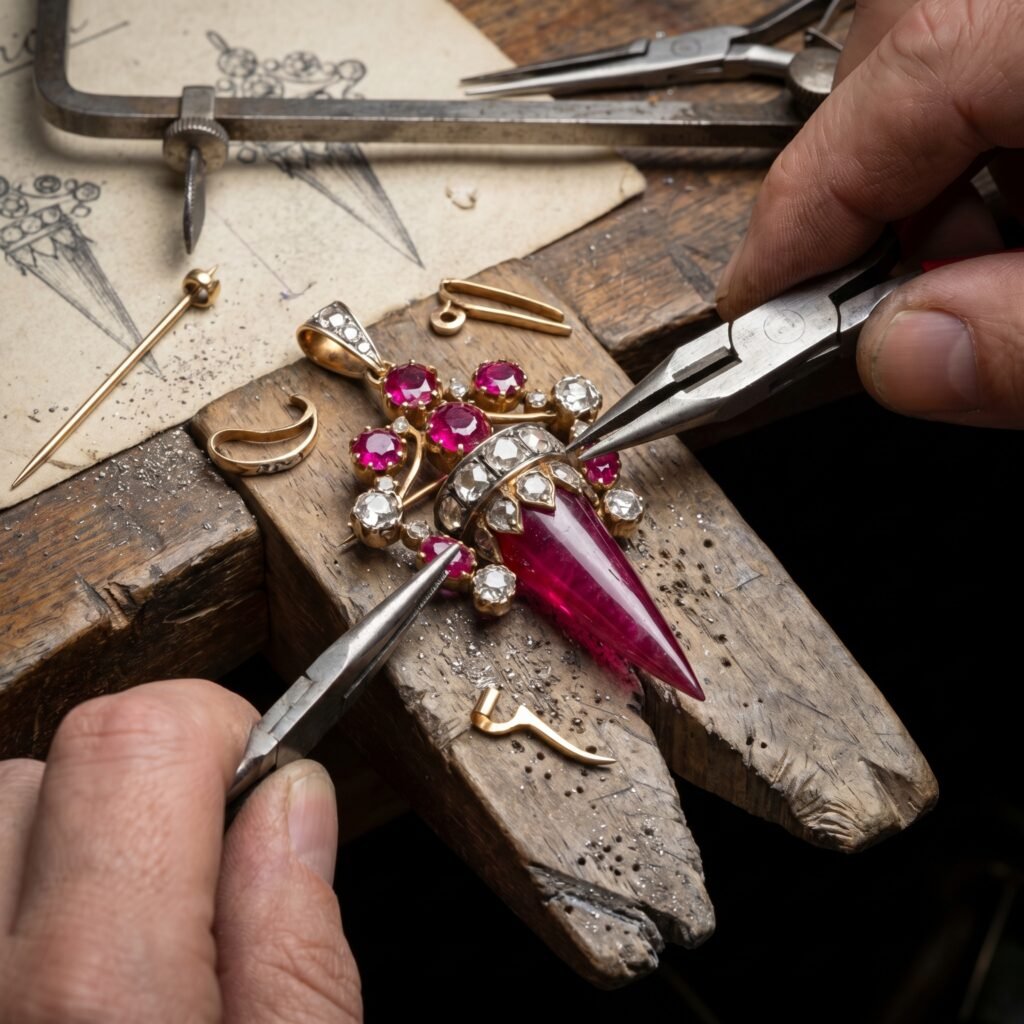
Her current signature is a Victorian-era ruby spike once fashioned from an antique brooch. The elongated form, now worn as a pendant, embodies qualities she associates with the stone: strength, courage, fidelity and loyalty. Because original Victorian spikes are scarce and often prohibitively priced, Cyndi has started producing analogous pieces from Art Deco stickpins. As a result, she positions the modern iterations as accessible statements for collectors seeking a compact emblem of resilience. “Everyone needs a reminder that they are strong,” she said, framing the design as an invitation to “find your inner badass goddess.”
From Paris Flea Markets to Global Trade Shows
Cyndi’s path into the community began online with eBay listings and in person at neighborhood antique stores. However, a trip to the Marché aux Puces de Saint-Ouen, commonly known as the Paris Flea Market, broadened her exposure to European dealers. Over time, she learned, largely through relationship-building, how to locate “hidden gems” in local shops and distant markets alike.
Similarly, that network expanded further on Portobello Road in London, where guidance from dealer Ishy of @IshyAntiques helped her navigate booths and build confidence as a buyer. Trade shows soon became pivotal. For example, the Hillsborough Antiques + Art Show introduced Cyndi to Cristina and Nicole of @treasuresforliesel at a booth operated by Lenore Dailey.
Subsequently, events in Las Vegas brought partnerships with Lindsey of @parkavenueantiques and Laurie Geller @laurie.geller. Furthermore, Miami’s jewelry show added further connections, including an encounter with the author of the original profile that cemented the friendship behind this report. Cyndi describes the group that emerged from these shows as a “little jewelry gang” whose mutual support persists well beyond social media. This community support is a reflection of the broader jewelry trends of 2026, where shared passion for history is more valuable than ever.
Egyptian Revival and the Art of Restoration
Much of her inspiration is anchored in historical movements. For instance, the Egyptian Revival style surged after the 1922 discovery of Tutankhamun’s tomb. Examples of the genre, such as winged scarab brooches, populate major museum collections; consequently, the Metropolitan Museum of Art holds several pieces that illustrate the era’s fascination with ancient motifs. Cyndi’s admiration for those artifacts informs her own hunts for brushed-gold serpents and lotus-inspired elements.
While she remains an active buyer, the collector places equal emphasis on conversion and restoration. In fact, reworking an antique Victorian jewelry element into a modern context often involves resetting stones, altering mountings or engineering entirely new structures from salvaged fragments. Nevertheless, each project seeks to honor the craftsmanship of the original makers while granting the object relevance for contemporary wearers.
By focusing on motifs that resonate personally—celestial bodies, numerals, protective symbols—she curates a collection that is both identifiable and meaningful. Social media plays a central role in showcasing these finished pieces. In addition, followers recognize her feed by the consistent presence of ruby accents, diamond-dust wings and vintage medallions. That visual cohesion, she believes, stems from deliberate selectivity rather than volume.
Conclusion: Preserving History Through Modern Functionality
Looking ahead, Cyndi plans to continue sourcing antique components while broadening the Lucky Numbers line. Overall, she also anticipates a full schedule of trade shows once pandemic disruptions subside, expecting reunions with international colleagues across venues in California, Nevada and Florida.
Ultimately, the ongoing objective remains unchanged: to locate fragments of the past, translate them for present-day use, and preserve the emotional narratives that make jewelry more than decorative. Cyndi’s journey underscores the confluence of history, craft and personal symbolism in the antique jewelry sector. Therefore, by blending century-old elements with modern functionality, she offers collectors a way to wear heritage pieces as daily affirmations. These objects are, as a result, at once fashionable and deeply individual.

Cassia Freitas holds a degree in Business Administration and a specialization in Fashion Design. She has been working as a jewelry designer since 2012 and is passionate about everything related to style, beauty, and authenticity. As the creator of the blog Sublime Jewels, she shares tips, inspirations, and practical suggestions for those who love fashion, accessories, and want to express their personality with elegance in everyday life.