A platinum lapis ring produced in 1930 has emerged as a centerpiece of discussion among dealers and collectors following its recent appearance at the New York City Jewelry and Object Show (NYCJAOS). Exhibited by London-based dealer The Vintage Jewellers, the piece is notable for its rare combination of lapis lazuli, onyx, and old cut diamonds. Consequently, these features situate it squarely within the late Art Deco period while also displaying elements of the era’s Egyptian-revival influence.
Design and Materials of the 1930 Lapis Ring
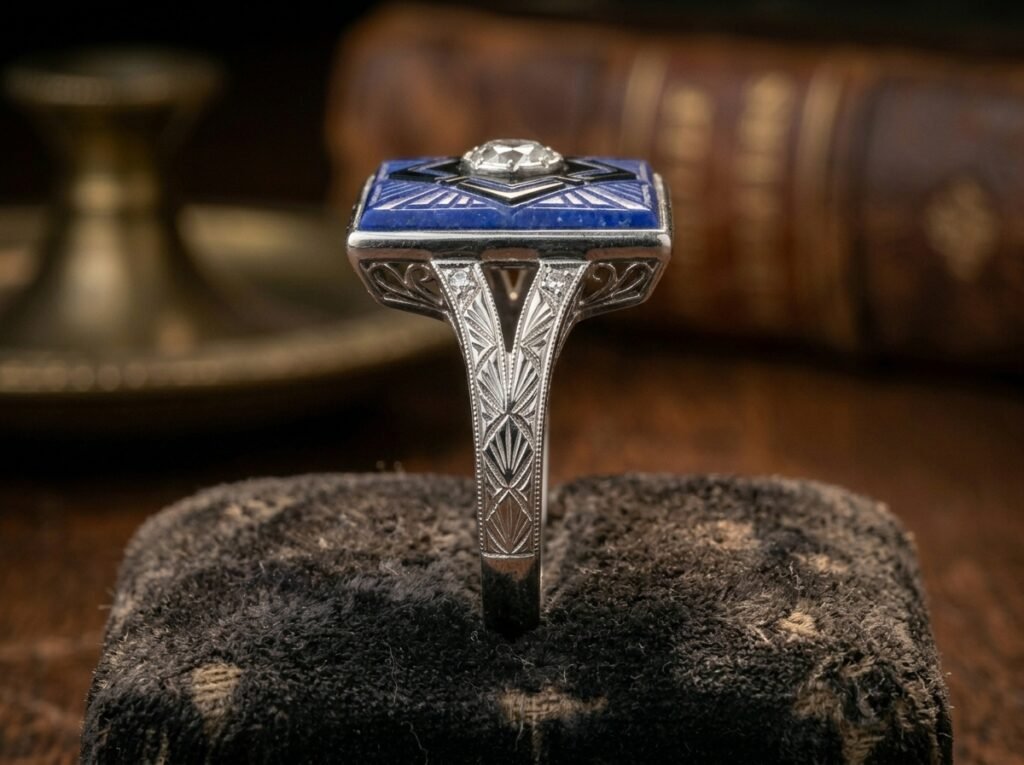
The structure of this exquisite lapis ring begins with a platinum shank that tapers into split shoulders. Each shoulder is set with old cut diamonds, a popular choice in the early 20th century before the modern round brilliant became standard. The shoulders curve upward and terminate in flared ends whose silhouette recalls the lotus and fan motifs associated with Egyptian iconography. Moreover, scholars at the Metropolitan Museum of Art note that such motifs experienced renewed popularity after the discovery of Tutankhamun’s tomb in 1922, influencing a wide range of decorative arts during the 1920s and 1930s.
Above the diamond-set shoulders sits a domed, square tablet of lapis lazuli. The gemstone is carved with vertical channels along all four edges, creating a striped pattern that emphasizes the stone’s saturated blue color and subtle pyrite flecks. In addition, that lapis platform is further embellished with a square inlay of deep black onyx. The onyx acts as a dramatic border for the ring’s focal point: a 0.40-carat old cut diamond mounted at the center of the design. Together, the lapis and onyx form a striking color contrast that was frequently employed by Art Deco jewelers seeking bold geometric effects in every lapis ring of the era.
Craftsmanship Details and Art Deco Engineering
From a construction standpoint, the lapis ring offers several hallmarks of late-period Art Deco craftsmanship. First, the negative space formed by the split shoulders creates an open area beneath the lapis mounting, reducing overall weight while adding visual lightness. Furthermore, the ring’s platinum setting allows for precise, fine-edged mounts, a technical advantage that platinum provided over yellow gold and silver during that decade.
The channels carved into the stone of this lapis ring are not merely decorative; they help disguise the seating of the stone within a low bezel, keeping the profile modest enough for regular wear. Similarly, the onyx insert is precision-cut to nest flush within the lapis, illustrating the level of lapidary skill required to achieve tight tolerances in two different hardstones. The use of old cut diamonds—stones characterized by a high crown and small table—links the piece to jewelry traditions that predate the advent of modern diamond-cutting machinery. This attention to detail is what defines the jewelry trends of 2026, where vintage craftsmanship and architectural integrity are once again at the forefront of luxury.
Market Context and Collector Demand
Art Deco jewels featuring carved hardstones remain in steady demand among global collectors. Pieces that combine lapis lazuli and onyx, in particular, command attention because the two materials deliver a distinct color juxtaposition that is immediately recognizable as period-specific. In fact, the inclusion of Egyptian-revival motifs can further elevate interest, as these designs speak both to the 1920s fascination with archaeology and to the wider modernist movement that emphasized streamlined, geometric forms.
The Vintage Jewellers has confirmed that the lapis ring is available for private sale. Although pricing details were not disclosed at the booth, comparable Art Deco rings with similar carat weights and platinum settings have fetched mid-five-figure sums at recent auctions, depending on provenance and condition. Therefore, the present example shows minimal evidence of restoration, retaining crisp engraving on the lapis, factors that typically contribute to stronger valuations. Collectors often look for the ring finger meaning and history when investing in such symbolic and historical pieces.
Historical Significance of the Lapis Ring
The lapis ring encapsulates several threads of early-20th-century design history: the adoption of platinum for fine settings, the incorporation of vivid colored stones alongside monochromatic accents, and the ongoing influence of archaeological discoveries on jewelry aesthetics. Its date of manufacture, 1930, positions it near the end of the Art Deco period, when jewelers were refining earlier geometric experiments into increasingly sophisticated compositions.
Specifically, while larger diamond solitaires of the era often dominate headlines, mixed-material rings such as this example illustrate the breadth of creativity that characterized high jewelry workshops in the interwar years. Pieces that marry architectural mountings with carved hardstones remain less common on today’s market, enhancing their appeal to both seasoned collectors and new entrants seeking differentiated acquisitions.
Ultimately, the ring’s blend of lapis lazuli, onyx, and diamond—executed with discipline typical of 1930 workshops—offers a concise illustration of how Art Deco jewelers balanced color, geometry, and metallurgy. Whether acquired for private enjoyment or future exhibition, the piece stands as a tangible record of a design movement that continues to resonate with contemporary audiences nearly a century after its creation. The lapis ring remains a testament to an era of unparalleled elegance and structural innovation.

Cassia Freitas holds a degree in Business Administration and a specialization in Fashion Design. She has been working as a jewelry designer since 2012 and is passionate about everything related to style, beauty, and authenticity. As the creator of the blog Sublime Jewels, she shares tips, inspirations, and practical suggestions for those who love fashion, accessories, and want to express their personality with elegance in everyday life.