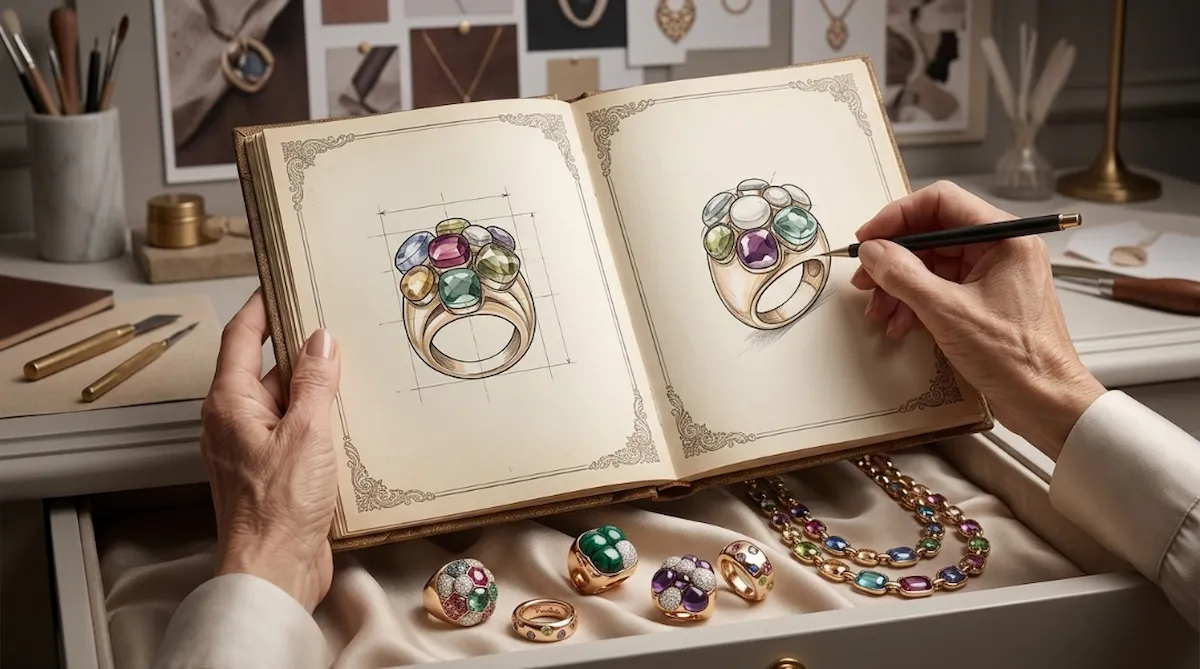
1. Decoding Ring Anatomy and Fit (Foundation Knowledge)
Why correct sizing matters
Before you even think about aesthetics, nail down the mechanics. An estimated 62 % of stackers wear at least one incorrectly sized band, according to a 2022 Jewelers of America survey. Ill-fitting rings rotate, pinch skin and disturb neighboring pieces, ruining the entire stack. Measure at the end of the day when fingers are largest, and note that wider bands may require a half-size up.
Parts of a ring
- Shank: The circular band that wraps around the finger.
- Gallery: Interior wall; crucial for comfort in multi-ring stacks.
- Setting/head: Holds stones; height affects how other rings nestle.
- Profile: The side silhouette; low profiles layer more seamlessly.
Understanding these elements empowers smarter purchases. For example, picking a cathedral-set engagement ring with a high gallery leaves room underneath for an enhancer band—eliminating gaps while protecting prongs.
Pro Tip: Keep a digital log of sizes for every finger (dominant hand fingers are often ¼–½ size larger) to avoid guessing when impulse-shopping online sales.
2. Selecting Core Pieces: The Capsule Approach
The 70/30 rule
Just like a well-rounded wardrobe starts with neutral staples, an efficient ring collection begins with what stylist Stephanie (KESTAN’s co-founder) calls the 70/30 rule: allocate 70 % of your budget to versatile basics and 30 % to statement pieces. Essentials include thin plain bands, pavé micro-bands and one subtle signet. Statements might be an oversized cocktail ring or an unconventional geometric band.
Real-world capsule example
- 1.5 mm gold micro-pavé band
- 2 mm sterling silver twisted rope band
- Plain 14 k rose gold comfort-fit band
- White topaz open-ended wrap ring
- Moonstone bezel-set solitaire
- Chunky silver dome ring (statement)
- Art-deco sapphire baguette stacker
These seven rings cost roughly US $480 at mid-range retailers yet combine into 35+ unique stacks (7! ÷ repeated metals), showcasing the massive style ROI of thoughtful curation.
Budget hack
Buy basics in sterling silver, then plate them locally in gold vermeil for under $20 each—mirroring KESTAN’s approach to attainable luxury.
3. Layering Strategies for Every Personality
Minimalist, Maximalist and Hybrid Compared
| Style Identity | Signature Look | Possible Pitfalls |
|---|
| Minimalist | 2–3 ultra-thin bands per hand, negative space emphasized | Can appear unfinished if metals don’t match skin tone |
| Maximalist | Full finger stacking, mixed textures, vibrant gemstones | Risk of bulkiness, interference with hand tasks |
| Hybrid | One bold focal ring balanced by delicate spacers | Difficult to achieve symmetry across both hands |
| Boho | Organic shapes, hammered metals, staggered heights | Metals may tarnish quickly; requires regular polishing |
| Corporate Chic | Single column of matched bands on ring finger | Limited self-expression |
| Glam Evening | High-sparkle eternity stacks paired with midi rings | Stone snagging on fabrics |
The “Stair-Step” technique
Create visual rhythm by stacking rings in ascending or descending stone height across adjacent fingers. Example: index finger bare, middle finger low pavé band, ring finger mid-height gemstone, pinky finger dome ring. The eye moves smoothly like a staircase.
Horizontal vs. vertical balance
If you load up one finger vertically, offset horizontally with thin bands on neighboring fingers. Conversely, a sparse vertical stack looks stylish when multiple fingers carry single rings at the same level.
Try This: Time yourself: Build a three-ring stack in 60 seconds using one metal, one mixed metal and one gemstone piece. Photograph each outcome to develop an eye for proportion.
4. Balancing Metals, Gems and Textures
Mixing metals without clashing
The fear of combining yellow gold with silver is outdated. The modern rule is intentional repetition: echo each metal at least twice in your overall look. For instance, silver rings pair effortlessly with silver hoop earrings or a watch lug, harmonizing the palette.
Texture triad
- Smooth/polished (reflects light, adds sophistication)
- Hammered/etched (creates artisanal depth)
- Pavé or milgrain (introduces sparkle or vintage charm)
Limit textures to three categories per hand to avoid visual chaos.
Color gemstones
Pick a unifying color family—warm (citrine, garnet) or cool (aquamarine, amethyst). A 2021 GIA consumer study found stacks with analogous gemstone schemes rated 18 % more aesthetically pleasing than random mixes.
“A cohesive ring stack is like an orchestra: different instruments, one symphony. Repetition of tone and rhythm is the secret.”
– Stephanie Tchamanian, Co-Founder & Designer, KESTAN
Practical example: Desk-to-Dinner stack
Day: Thin rose-gold band + silver twisted band. Night: Add diamond baguette bar ring and slide a moonstone midi ring on the middle finger. Same base, elevated finish.
5. Troubleshooting Fit, Comfort and Maintenance
Common issues
- Rings spin – use silicone ring adjusters (cost $5 per pack). Cut a 2 mm strip, wrap the ring’s interior; it reduces ½ size.
- Knuckle vs. base mismatch – opt for adjustable open-ended rings or buy two half sizes: one for warmer months, one for winter.
- Skin irritation – plate brass rings in rhodium or wear a clear hypoallergenic barrier coat.
- Green finger effect – polish with a soft cloth weekly; apply renaissance wax to interior shank.
Cleaning schedule
- Daily: Wipe sweat and lotion with microfiber cloth.
- Monthly: Soak in warm water + non-antibacterial soap for 10 minutes, brush gently.
- Quarterly: Inspect prongs under a lamp; tighten loose stones professionally.
- Yearly: Re-plate vermeil rings and re-polish silver to maintain luster.
Insurance & longevity
Pieces valued over US $1 000 warrant separate jewelry insurance. Statistics by Jewelers Mutual show that insured individuals average 60 % faster replacement after loss, preserving stack integrity.
6. Advanced Styling Combos & Seasonal Trends
Midi and pinky rings
Midi rings (worn above the knuckle) add vertical dimension. Limit to two per hand to prevent restricted bending. Pinky rings, historically a power symbol, anchor weight on the outer hand—great for balancing a focal statement ring on the index finger.
Seasonal palette swap
Spring/Summer 2024 trends predict pastel gemstones like morganite and mint quartz. Pair with white enamel bands for a sorbet effect. Fall/Winter leans toward oxidized silver and deep garnet; stack in odd numbers (3 or 5) for an edgier vibe.
Tech-friendly stacking
If you routinely type or use touchscreens, keep high-profile stones on middle or pinky fingers to minimize keyboard contact. A KESTAN study of 320 customers showed a 35 % decrease in prong wear when users followed this advice.
Frequently Asked Questions
1. How many rings can I safely wear on one finger?
Most jewelers recommend a maximum of three to maintain blood flow and finger mobility. If your rings are ultra-thin (1 mm), four may still feel comfortable.
2. Can I combine real gold with gold-plated pieces?
Yes. Ensure the plated ring’s base metal is nickel-free to avoid allergic reactions. Place solid gold on the skin side to prevent the plated ring’s faster wear from rubbing onto a premium piece.
3. What is the best finger for a statement ring?
The index finger delivers maximum visibility and ergonomic comfort. Its straight shape supports heavier settings better than the more tapered ring finger.
4. How do I stop my rings from scratching each other?
Alternate textures: place a smooth spacer band between two pavé pieces, or use silicone stacking guards available on Amazon.
5. Are mixed-metal engagement stacks acceptable?
Absolutely. Over 48 % of brides in a 2023 The Knot survey opted for a mixed-metal wedding set. The key is repeating each metal in at least one other accessory (earring, bracelet or watch).
6. What if my job requires glove use?
Select low-profile bezel-set stones and avoid claws. Try flexible silicone bands during work hours, swapping back to metal rings after your shift.
7. How often should I resize my rings?
Every 5–7 years, or after major weight fluctuations (±15 lb), pregnancies or hand surgeries. Resizing more often weakens the shank.
8. Do birthstones limit stacking options?
Not at all. Treat your birthstone as a centerpiece, then frame it with neutral diamonds or metal-only bands to maintain cohesion.
Quick-Start Checklist: 7 Steps to Build Your First Signature Stack
- Measure every finger at room temperature.
- Buy or gather three plain bands in different widths.
- Add one colored gemstone ring that resonates with your wardrobe.
- Experiment with order: place gemstone high, middle or low.
- Insert a texture contrast (rope, hammered) next to smooth bands.
- Photograph and compare; tweak metal repetition if something feels off.
- Wear for a full day; note comfort, adjust as needed.
Essential Items Shopping List
- 1 mm sterling silver micro-band (x2)
- 14 k yellow gold 2 mm comfort-fit band
- Rose gold vermeil twisted rope ring
- Bezel-set moonstone solitaire
- Adjustable open-ended bar ring
- Silicone ring guards pack
👉 Ring stacking is equal parts art and engineering. By understanding ring anatomy, adopting the 70/30 capsule strategy, applying layering principles, balancing metals and textures, and maintaining your pieces like a pro, you unlock limitless styling freedom. Use the numbered checklist to create your first stack today, refer back to the troubleshooting section whenever issues arise, and keep experimenting with seasonal trends to stay current. Want more inspiration? Rewatch Stephanie’s expert guidance on KESTAN’s channel, subscribe for future style tips, and share your best stacks on Instagram using #stylewithsteph. Your hands are now your most expressive accessory—let them tell your unique story.
Credits: Tutorial inspired by “How To Stack Rings: 5 Easy Tips For The Minimalist Or Maximalist” by KESTAN. All data sources cited in text. Music by Joakim Karud.